La meilleure application pour mesurer la hauteur d'un mur dépend de vos besoins. Pour une vérification rapide, l'application Mesures intégrée à votre iPhone suffit. Pour capturer toutes les hauteurs d'une pièce et les conserver, scannez-la avec Polycam et mesurez depuis le modèle. Le télémètre laser reste également une option pertinente, et ce guide vous explique quand l'utiliser.
Points clés
- A Polycam scan on a LiDAR iPhone or iPad captures every wall height in a room, and you can measure from it long after you’ve left.
- Match the tool to the job. Paint and wallpaper estimates tolerate small errors.
- Phone LiDAR is reliable to about 5 meters (16 feet) per surface. Taller walls need a laser measure.
Quelle est la meilleure application pour mesurer la hauteur d'un mur ?
| Tool | Best for | Walls per session | Coût |
|---|---|---|---|
| Apple Measure | Checking whether one bookcase or headboard clears the ceiling | One at a time, with no record of the room | Free, built into iPhone |
| Polycam | Ordering paint, wallpaper, or paneling for a whole room | The whole room from one scan | Scanning and the Ruler on the Free plan. Auto Measure from Basic, and the Spatial Report on Business |
| Laser distance meter | Walls over 16 feet and critical cuts | Un par un | Hardware purchase |
Apple’s Measure app acts like a tape measure in augmented reality. On iPhone 12 Pro and newer, the LiDAR Scanner adds guide lines for heights and straight edges. The app is fast, but it only gives you one number at a time and doesn’t save your measurements. With a scan, you record the whole room, so you can always check any height you missed later.
How Accurate Does Your Wall Height Need to Be?
Paint and wallpaper projects are flexible. On a 12-foot wall, being off by half an inch only changes the area by about half a square foot, which is less than what you’ll trim anyway. The same goes for curtain rods, artwork, and shelving. A scan provides all the accuracy you need for these tasks.
Built-in projects are different. Floor-to-ceiling cabinets, paneling, and bookcases need to fit exactly between the floor and ceiling, so there’s little room for mistakes. Use the scan to plan your design and make sure it’s close, but always confirm the final measurement with a tape or laser before cutting anything.
How to Measure Wall Height From a Polycam Scan
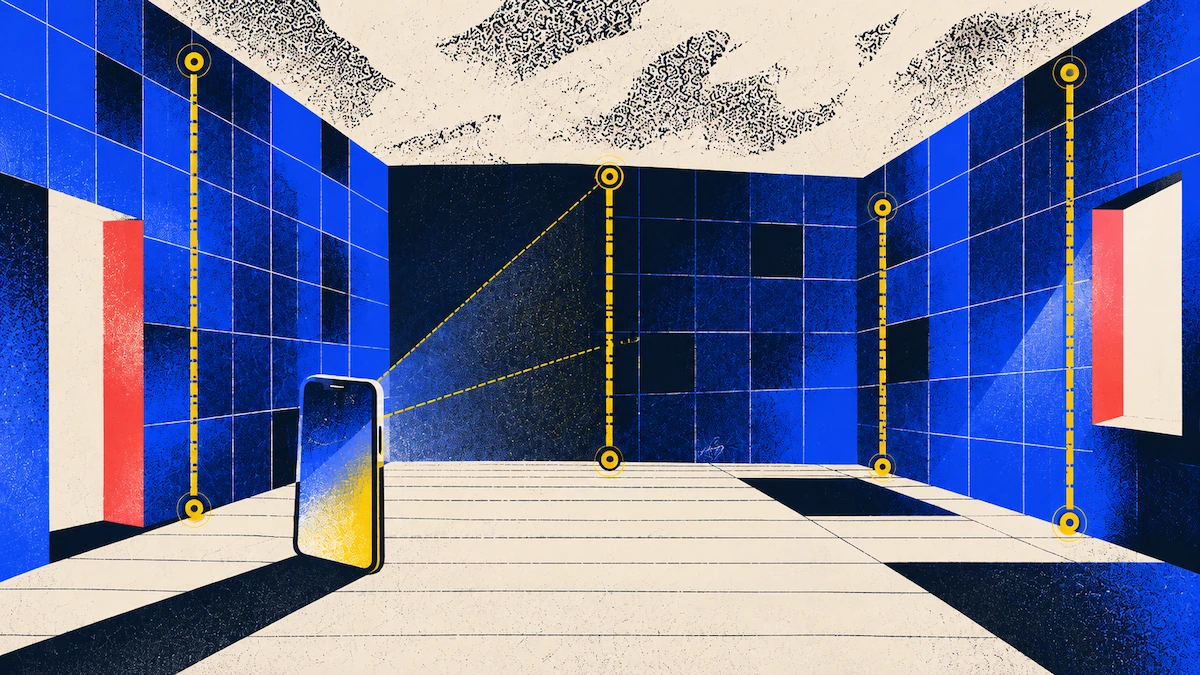
- Start by scanning the room with Polycam. Use Space or Floorplan mode on a LiDAR iPhone or iPad. Move slowly and sweep the phone up and down as you walk, so the scan captures the floor, the full height of each wall, and the ceiling. If you have trouble seeing a corner or the ceiling line, turn on the flashlight in the capture screen.
- Place the Ruler with care. Open your scan, tap the Measure icon, and select a point where the wall meets the floor and another point directly above it on the ceiling. It helps to zoom in on each end before placing the points, since your measurement depends on their accuracy. You can drag either point to adjust it. The Ruler tool comes with every plan and is free.
- Let Auto Measure handle the walls. On Basic and above, Auto Measure generates measurements for the walls it detects, so you don’t have to place every point by hand.
- Pull heights and wall areas for the whole space. On Business and Enterprise, the Spatial Report on Polycam for Web lists the ceiling height for each room. It also gives wall area with and without openings, which is the figure you’d order paint or wallpaper from.
Try it on one room. Download Polycam for free.
Where Wall Height Measurements Go Wrong
Most mistakes happen because of the room, not the phone. Floors and ceilings are often not perfectly level, especially in older homes. If you only measure in the middle of a wall, you might miss a low corner. For built-in projects, measure at both ends and in the center, and use the shortest measurement for your plans.
Trim can also cause problems. Before you measure, decide if you need the height to the ceiling or to the bottom of the crown molding, and place your points accordingly. Sloped and vaulted ceilings don’t have just one wall height. Measure at every spot that matters for your design, like the low wall, the high wall, and where you plan to put a light or shelf.
Wall height is also where your phone’s range can fall short. LiDAR works well up to about 5 meters per surface, so in a double-height living room or stairwell, use the scan for the layout but a laser for the height. If you miss anything while scanning, the software will estimate it, so always do a final check of the floor, ceiling, and every corner before you leave the site.
Apple’s Measure app acts like a tape measure in augmented reality. On iPhone 12 Pro and newer, the LiDAR Scanner adds guide lines for heights and straight edges. The app is fast, but it only gives you one number at a time and doesn’t save your measurements. With a scan, you record the whole room, so you can always check any height you missed later.
How Accurate Does Your Wall Height Need to Be?
Paint and wallpaper projects are flexible. On a 12-foot wall, being off by half an inch only changes the area by about half a square foot, which is less than what you’ll trim anyway. The same goes for curtain rods, artwork, and shelving. A scan provides all the accuracy you need for these tasks.
Built-in projects are different. Floor-to-ceiling cabinets, paneling, and bookcases need to fit exactly between the floor and ceiling, so there’s little room for mistakes. Use the scan to plan your design and make sure it’s close, but always confirm the final measurement with a tape or laser before cutting anything.
How to Measure Wall Height From a Polycam Scan
- Start by scanning the room with Polycam. Use Space or Floorplan mode on a LiDAR iPhone or iPad. Move slowly and sweep the phone up and down as you walk, so the scan captures the floor, the full height of each wall, and the ceiling. If you have trouble seeing a corner or the ceiling line, turn on the flashlight in the capture screen.
- Place the Ruler with care. Open your scan, tap the Measure icon, and select a point where the wall meets the floor and another point directly above it on the ceiling. It helps to zoom in on each end before placing the points, since your measurement depends on their accuracy. You can drag either point to adjust it. The Ruler tool comes with every plan and is free.
- Let Auto Measure handle the walls. On Basic and above, Auto Measure generates measurements for the walls it detects, so you don’t have to place every point by hand.
- Pull heights and wall areas for the whole space. On Business and Enterprise, the Spatial Report on Polycam for Web lists the ceiling height for each room. It also gives wall area with and without openings, which is the figure you’d order paint or wallpaper from.
Try it on one room. Download Polycam for free.
Where Wall Height Measurements Go Wrong
Most mistakes happen because of the room, not the phone. Floors and ceilings are often not perfectly level, especially in older homes. If you only measure in the middle of a wall, you might miss a low corner. For built-in projects, measure at both ends and in the center, and use the shortest measurement for your plans.
Trim can also cause problems. Before you measure, decide if you need the height to the ceiling or to the bottom of the crown molding, and place your points accordingly. Sloped and vaulted ceilings don’t have just one wall height. Measure at every spot that matters for your design, like the low wall, the high wall, and where you plan to put a light or shelf.
Wall height is also where your phone’s range can fall short. LiDAR works well up to about 5 meters per surface, so in a double-height living room or stairwell, use the scan for the layout but a laser for the height. If you miss anything while scanning, the software will estimate it, so always do a final check of the floor, ceiling, and every corner before you leave the site.
FAQ
Quelle est la meilleure application pour mesurer la hauteur d'un mur ?
Pour obtenir toutes les hauteurs d'une pièce, scannez-la avec Polycam sur un iPhone ou iPad LiDAR et mesurez depuis le modèle. Lors des tests de Polycam, la hauteur sous plafond correspondait exactement ou à quelques millimètres près à celle d'un télémètre laser. Pour une vérification rapide, l'application Mesures d'Apple est gratuite, bien qu'Apple qualifie ses résultats d'approximatifs.
L'application Mesures de l'iPhone est-elle assez précise pour la hauteur d'un mur ?
Elle convient pour des vérifications rapides, comme savoir si un meuble passera sous le plafond. Apple précise que ses mesures sont approximatives ; confirmez donc toute hauteur avant de commander des matériaux ou d'effectuer des découpes.
Puis-je mesurer la hauteur d'un mur avec un téléphone Android ?
La capture de pièce par Polycam nécessite un iPhone ou iPad LiDAR et n'est pas disponible sur Android. Il existe des applications de mesure en réalité augmentée sur Android, mais vérifiez si le développeur publie une marge d'erreur avant de commander des matériaux.
Comment mesurer un mur de plus de 5 mètres de haut ?
Utilisez un télémètre laser. Le LiDAR des téléphones est fiable jusqu'à environ 5 mètres par surface ; le scan capture bien la disposition de la pièce, mais ne doit pas servir de référence pour la hauteur d'un mur élevé.